
Ripley County Court Records After Arrest
The local path is arrest, booking, prosecutor review, filed charges, and court case tracking. The Ripley County Jail's current inmate list can show booking numbers, offense descriptions, statutes, and offense classes. The daily arrest report can show arrest time and date, cause number, age, arrest type, arrest number, agency, and related incidents. Those sheriff records help identify the event, but the court record starts when a non-confidential case is filed and processed through the Indiana court system.
Ripley County uses county prosecuting attorneys rather than a district attorney title. Prosecutor Richard J. Hertel's office reviews law-enforcement reports and decides what charges to file. The charge that appears on the jail report can differ from the charge later filed in court. Charges can be added, amended, reduced, dismissed, or resolved by plea or trial. For custody and booking fields, use Ripley County jail inmate records; for booking-photo limits, use Ripley County jail mugshots.
Find Ripley County Court Records
The official statewide public case-search portal is Indiana MyCase. It searches non-confidential Indiana cases and is linked through the Indiana Judicial Branch. The Indiana Judicial Branch Ripley County page also lists local court contacts, MyCase, e-filing, local rules, court statistics, and District 22 information. If a document is not available online, the court page directs users to contact the local court maintaining the record.
The Indiana MyCase search page is shown here: Indiana MyCase public case search.
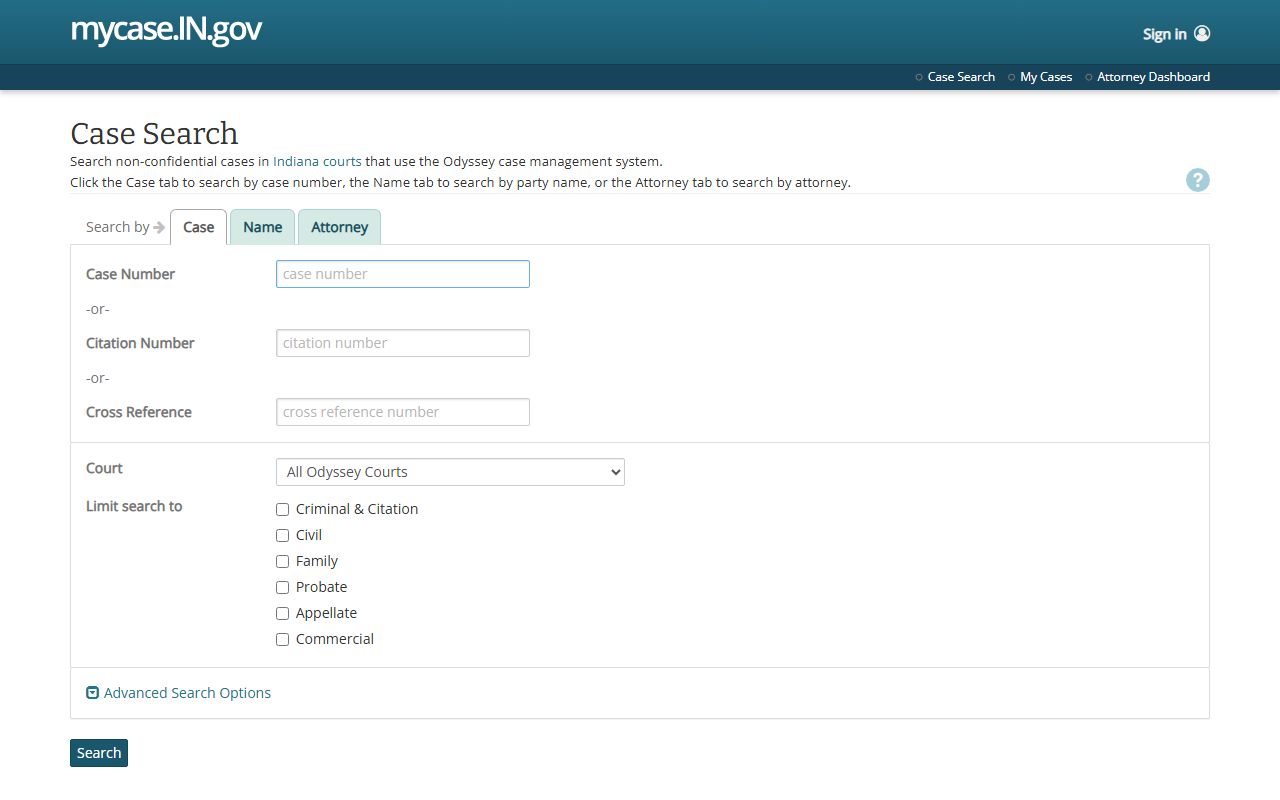
MyCase is the court-record search path, while the sheriff roster remains the custody and booking-record path.
- Open MyCase and search by defendant name when no cause number is known.
- Use the cause number from the daily arrest report, court notice, or jail paperwork if available.
- Filter or confirm Ripley County when several Indiana cases have similar names.
- Review the case summary, charges, hearing events, bond entries, warrants, and disposition fields.
- Contact the Clerk or court for certified copies, older records, or documents not available online.
Ripley County Case Search Fields
MyCase is a statewide court portal, so the search fields do not mirror the county jail roster. The strongest link between a jail arrest and a court record is a cause number. If a cause number is not listed yet, search by party name and watch for the court, filing date, charge description, and case number that match the arrest event.
Name searching needs care in court records after an arrest. A middle initial, suffix, spelling difference, or common name can return several Indiana cases. Match the county, court, approximate filing date, charge type, and any cause number from the daily arrest report before relying on a result. When the document itself is not online, the Clerk or court remains the official copy source.
| Field Label | Type | Required | Notes |
|---|---|---|---|
| Case or party search | Web search | Unspecified | Searches non-confidential Indiana cases. |
| Case number | Text | Optional | Use the cause number if shown on a report or court notice. |
| Party or defendant name | Text | Optional | Useful when the cause number is unknown. |
| Court or county filters | Filter | Optional | Use Ripley County when available. |
| Official copies | Local court request | As needed | Copies come from the court that maintains the record. |
Ripley County Court Offices
Ripley County court records after a jail arrest may involve the Clerk, Circuit Court, Superior Court, and Prosecutor. The courthouse address is 115 N. Main Street in Versailles for these offices, with separate mailing boxes and phone numbers. The Clerk handles court records and bond payment during courthouse hours, while the prosecutor decides what criminal charges to file.
Ripley County Clerk
115 N. Main Street
P.O. Box 177, Versailles, IN 47042
812-689-6115
Monday-Friday, 8 a.m.-4 p.m.
Ripley County Prosecutor
115 N. Main Street
P.O. Box 102, Versailles, IN 47042
812-689-6331
Monday-Friday, 8 a.m.-12 p.m. and 1-4 p.m.
Charges Filed After Arrest
Indiana criminal cases begin through charging documents. In local practice, many post-arrest cases move from police report to prosecutor review to an information or complaint. An indictment is possible in serious matters but is not the routine public path for every county jail booking. The key point is that the jail's offense line is not the final court charge by itself.
| Document | Who Files It | What It Does |
|---|---|---|
| Complaint | Officer or prosecutor path | Starts or supports a criminal accusation after an arrest. |
| Information | Prosecutor | Lists formal charges chosen by the prosecutor. |
| Indictment | Grand jury | Charges a case through grand-jury action in qualifying matters. |
Ripley County Charge Status
A case can change after the first filing. A booking entry may say one offense, while MyCase later shows a different charge level or a dismissed count. That does not always mean the jail report was wrong. It often means the prosecutor reviewed the facts, selected a different charge, or resolved part of the case. Always read the current court docket before relying on a roster offense line.
| Status | What It Means |
|---|---|
| Pending | The charge is still active and has not reached final disposition. |
| Amended | The charge wording, level, or count has been changed by court filing. |
| Reduced | The charge has been lowered, often through negotiation or amended filing. |
| Dismissed | The court record shows the count or case was dismissed. |
| Convicted | The case ended in a guilty plea, finding, or verdict on that charge. |
Bond After a Jail Arrest
Bond information may appear in court records, jail instructions, or direct jail communication. Ripley County's jail visitation page tells users to contact the jail first for the correct bond amount. During courthouse business hours, bond is paid at the Clerk's office by money order or cashier's check. After courthouse hours, bond can be paid at the jail by postal money order or a cashier's check from a local bank. GovPay is also listed, with a service fee.
| Bond or Release Type | Local Meaning |
|---|---|
| Cash or money bond | Money is posted to secure release and future court appearance. |
| Surety bond | A licensed bail agent or surety posts bond under Indiana rules. |
| Recognizance release | The court releases a person without money bail when allowed and conditions are met. |
| No-bond or hold | A warrant, detainer, probation/parole issue, or court order blocks release. |
| GovPay bond | A payment channel listed by the county, with service fee. |
Warrants and Court Records
No official Ripley County active-warrant search database was located. That does not mean warrants are absent from court and jail records. The daily arrest report inspected during research included "Arrest Type: WAR," showing that warrant arrests flow into the jail report path after the person is booked. Bench warrants may also appear in MyCase when tied to a non-confidential court case.
A person who believes they may have a warrant should not rely only on web search. The safer route is to contact counsel, the issuing court, the Clerk, or the sheriff for instructions. A daily arrest report is after-the-fact evidence of a warrant arrest, not a prospective warrant lookup.
- Arrest warrant
- A court order authorizing arrest.
- Bench warrant
- A court warrant often tied to failure to appear or violation of a court order.
- Hold warrant
- An outside-agency or outside-jurisdiction hold that can affect release.
Charges vs Convictions
An arrest and a charge are not convictions. The sheriff page's reminder that each person is innocent until proven guilty is important for reading Ripley County records. A jail roster shows custody and offense information. A court case shows the legal charge path. A conviction exists only after a guilty plea, finding, or verdict.
| Point | Charge | Conviction |
|---|---|---|
| Stage | Accusation or filed count | Final guilt finding or plea |
| Record source | Jail report or court filing | Court judgment or disposition |
| Can change? | Yes, charges can be amended or dismissed | Changes require later court action |
Sealed and Expunged Records
Indiana expungement and restricted-disclosure rules are found in IC 35-38-9. Eligibility depends on the record type, outcome, waiting periods, and statutory exclusions. A dismissal or expungement issue should be handled through the court record and the originating agencies, not through a private takedown claim.
| Record Treatment | Practical Effect | Where to Start |
|---|---|---|
| Sealed or restricted | Public access is limited by court order or statute. | Court file and Clerk process. |
| Expunged | Eligible records receive restricted disclosure under Indiana law. | Petition under IC 35-38-9. |
| Juvenile protected | Names and details may be withheld or replaced in public reports. | Court and agency-specific rules. |
Public Access and Limits
Indiana APRA supports inspection and copying of public records, but it also permits withholding or redaction of confidential, juvenile, investigatory, and safety-sensitive material. MyCase covers non-confidential court cases. Court copies and certified records should come from the court maintaining the record. Sheriff reports and law-enforcement recordings follow the sheriff records path and APRA procedures.
The public should also separate court records from consumer background checks. A docket may show an arrest-related charge that was later amended or dismissed. A screening company may have its own legal duties under federal and state law. The court record is best read at the source, with attention to the most recent docket entry and disposition.
Important: Court records, jail records, and background screening reports are different products with different legal limits.